Hooke’s Law Experiment
Content
- Abstract
- Introduction
- Theory
- Method
- Results and Discussion
- Conclusion
- Reference
Abstract
The main aim of this experiment is to determine the relationship between the force applied onto a material and it’s deformation. The experiment is carried out using two different materials in which both materials are exerted with force within their elastic limit. A second experiment is carried out with another material and the material is exerted with force exceeding it’s elastic limit to study the behaviour of a material when it’s elastic limit is exceeded. The deformation or the extension of the materials is then calculated and a graph of deformation against the force applied is plotted. The result agrees with Hooke’s Law in which the extension of a material is directly proportional with the force applied provided the elastic limit of the material is not exceeded. Meanwhile, the material exerted with force exceeding it’s elastic limit entered the plastic region where permanent deformation had occurred.
Introduction
Elasticity is a property of a material which enables it to return to it’s original shape and size when the force acting on it is removed. The elastic property of a material is caused by the existence force of attraction and repulsion between the molecule of the material. For instance, when an object is applied with a compressive force, the object will be compressed and the distance between the molecule in the object is reduced. At this point, a net force of repulsion will form between the molecule. When the compressive force is removed, the force of repulsion between the molecules of the compressed material will push the molecules back to the original position. Thus the material returns to it’s original length and the force of repulsion and attraction are balanced again (Foo et al. 2016, p. 143). An elastic material is also able to store elastic potential energy when work is done to stretch or compress the material. The amount of force required to extend or compress a material with a certain force constant can be determined with Hooke’s Law.

Source: https://www.goodreads.com/author/show/826340.Robert_Hooke
Hooke’s Law is a principle of physics introduced by a British physicist Robert Hooke (1635 – 1703) and he had demonstrated the relationship between the forces applied to a spring and its elasticity (Williams, 2015). The law was first stated by Robert Hooke in 1660 as a Latin anagram and the solution is published in 1678 (Universe Today, 2015).
In order to determine the elasticity of a material and their behaviour after the elastic limit is exceeded, an experimental investigation was carried out on the 3 materials to find out the relationship between the magnitude of force applied and the deformation of the materials.
Theory
The main theory involved in this experiment is Hooke’s Law. Hooke’s Law is a principle of physics which states that the extension or compression of a material is directly proportional to the force acting on it provided the elastic limit of the material is not exceeded (Foo et al. 2016, p. 145; Williams, 2015). Hooke’s Law can be expressed mathematically as
F = kx
, where F is the force acting on an object, k is the force constant or spring constant (if spring is the subject) and x is the extension, which is defined by
x = final length – initial length
The force constant of a material shows how stiff the material is. The higher the force constant, the larger the force is required to stretch or compress a material.
Method
A metre rule is attached vertically onto a retort stand. One end of Material 1 is attached onto the clamp of the retort stand while a pin is attached on the other end with plasticine. The initial length of Material 1, which is the value pointed by the pointer on the metre rule, is measured and recorded.
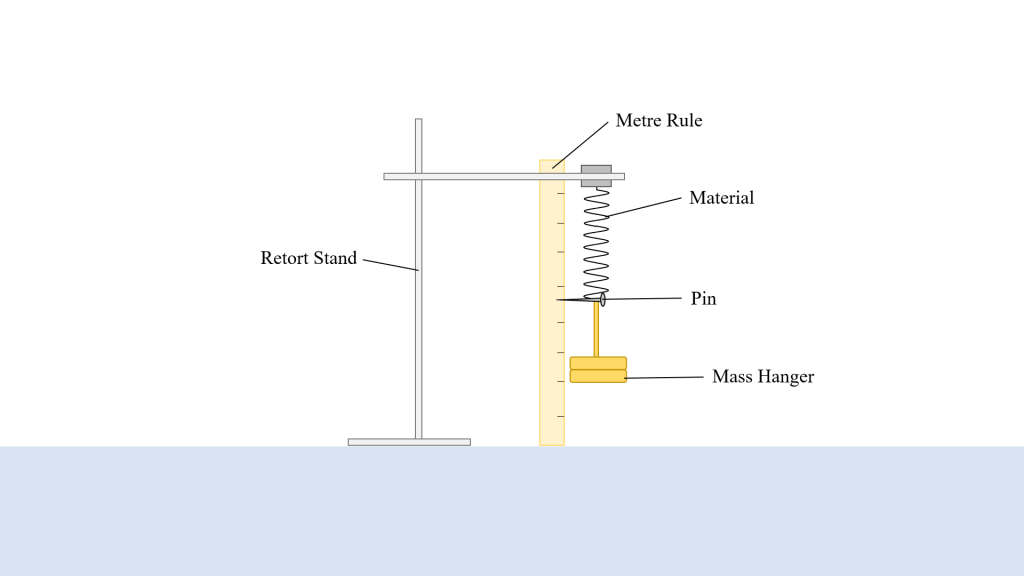
A mass hanger with a weight of 1N is hung onto the free end of the material. The final length of Material 1 is measured and recorded. The extension of Material 1 is then calculated by subtracting the initial length from the final length.
The experiment is repeated with an addition of 1N of weight until a maximum of 9N. The steps above is then repeated by replacing Material 1 with Material 2 and Material 3.
A graph of extension / deformation against the force applied is plotted.
Results and Discussion
In this report, all the values are obtained through the equations as shown below:
For Material 2:
y2 = (a + 0.5)x + c, where c = 0.2
For Material 3:
z = x3 + b
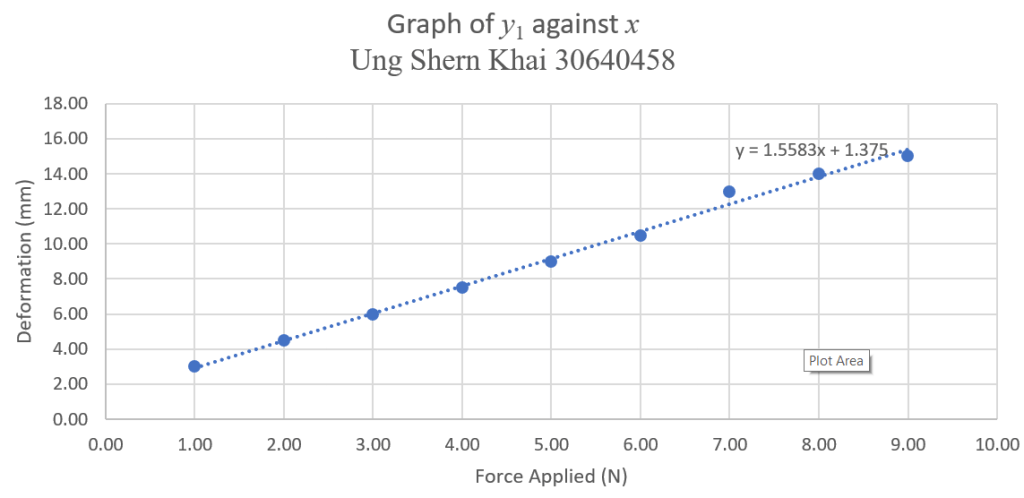
| Force Applied, x (N) | Deformation of Material 1, y1 (mm) |
| 1.00 | 3.00 |
| 2.00 | 4.50 |
| 3.00 | 6.00 |
| 4.00 | 7.50 |
| 5.00 | 9.00 |
| 6.00 | 10.50 |
| 7.00 | 13.00 |
| 8.00 | 14.00 |
| 9.00 | 15.00 |
Table 1
Both Table 1 and the graph above shows that the deformation of Material 1 increases linearly with the force applied. This shows that Material 1 obeys Hooke’s Law when the elastic limit is not exceeded.
The formula of y1 is given by y1 = ax + b, thus from y1 = 1.5583x + 1.375
a = 1.5583
b = 1.375
| Force Applied, x (N) | Deformation of Material 1, y1 (mm) | Deformation of Material 2, y2 (mm) |
| 1.00 | 3.00 | 2.26 |
| 2.00 | 4.50 | 4.32 |
| 3.00 | 6.00 | 6.37 |
| 4.00 | 7.50 | 8.43 |
| 5.00 | 9.00 | 10.49 |
| 6.00 | 10.50 | 12.55 |
| 7.00 | 13.00 | 14.61 |
| 8.00 | 14.00 | 16.67 |
| 9.00 | 15.00 | 18.72 |
Table 2
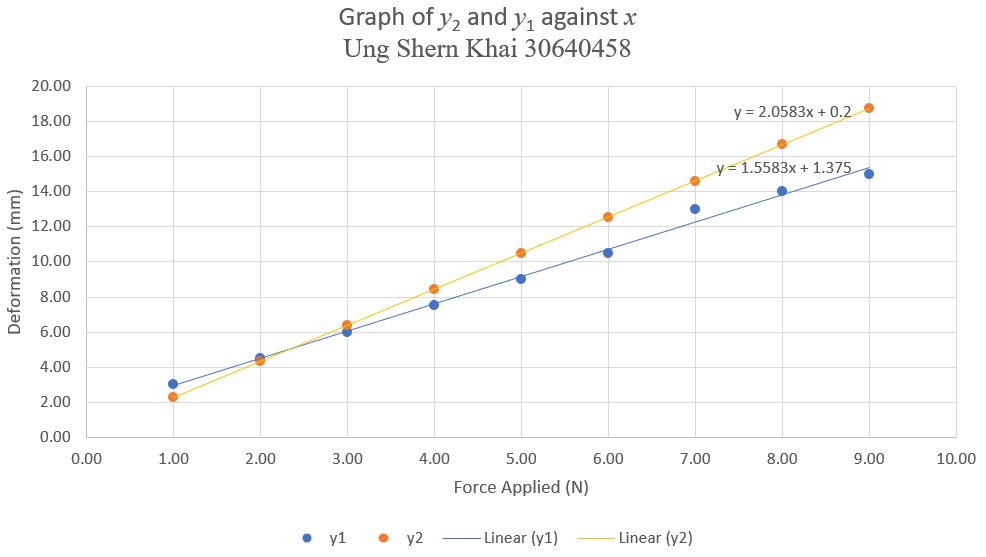
Figure 4 shows a graph that combines the deformation of both Material 1 and Material 2 on the same axis, thus we are able to compare the elasticity between the two materials easily. By observing graph in Figure 4, the gradient of y2, m2, is steeper than the gradient of y1, m1.
According to Hooke’s Law, the gradient of the graph will shows the force constant of the material which is the stiffness of the material and can be calculated with the formula :
k = F/x
However in Figure 4, the gradient of the graph, m, is
m = x/F
In order to obtain the force constant of both material, we need to take the reciprocal of m. For example:
For Material 1, m = 1.5583
k1 = 1 / 1.5583
k1 = 0.6417 N/mm
k1 = 641.7 N/m
For Material 2, m = 2.0583
k2 = 1 / 2.0583
k2 = 0.4858 N/mm
k2 = 485.8 N/m
From the above calculations, it is clear that Material 1 is more stiffer than Material 2 as it’s force constant is higher than Material 2. This means that more force is required to stretch or compress Material 1 than Material 2 to have the same extension.
From Figure 4, it is observed that the two lines intercept at a point in the graph and the value of the force applied when they intercept can be found be solving the simultaneous equations:
y = 1.5583x + 1.375
y = 2.0583x + 0.2
The simultaneous equation can be solved in Microsoft Excel with a matrix system by using the following formula:
{=MMULT(MINVERSE(A),(B))}
, where “A” is the cells which contains the value of x and y,
“B” is the cells which contain the value of the number, c, in the equation.
For instance,
| A | B | C | |
| 1 | x | y | c |
| 2 | 1.5583 | -1 | -1.375 |
| 3 | 2.0583 | -1 | -0.2 |
The intersection point can be found as follow:
{=MMULT(MINVERSE(A2:B3),(C2:C3))}
and the point of intersection, x, is 2.35N.
| Force Applied, x (N) | Deformation of Material 3, z (mm) |
| 1.00 | 2.38 |
| 2.00 | 9.38 |
| 3.00 | 28.38 |
| 4.00 | 65.38 |
| 5.00 | 126.38 |
| 6.00 | 217.38 |
| 7.00 | 344.38 |
| 8.00 | 513.38 |
| 9.00 | 730.38 |
Table 3
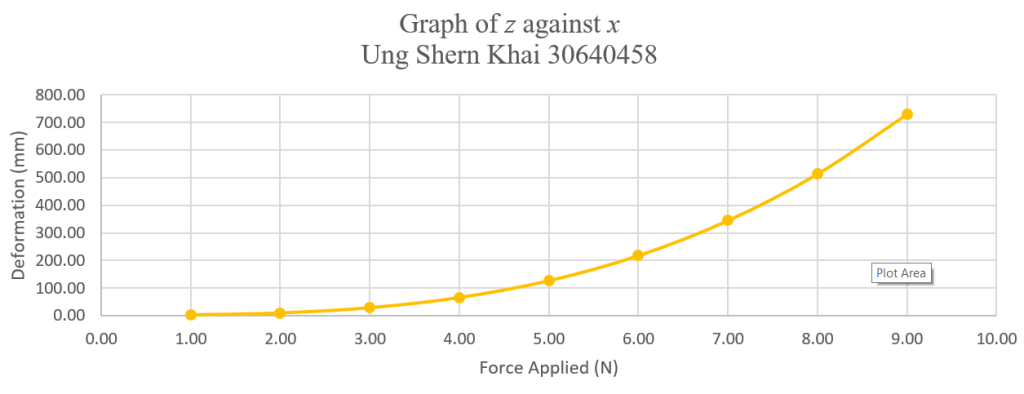
Figure 5 shows a graph with a different result from the previous graphs. The graph curves upwards instead of increasing linearly. This is due to the fact that the force applied to Material 3 had exceeded it’s elastic limit and is no longer obeying Hooke’s Law. At this point, Material 3 will not return to it’s original shape and size even after the force is remove. Material 3 is said to entered the plastic region where it’s shape and size is permanently deformed. Although it will still contract back when the force is removed but with a permanent extension.
When a material is applied with a stretching force, the material will extend linearly with the force and the material is said to obey Hooke’s Law. The force-extension graph should be a straight line passing through the origin.
However in Figure 3 and Figure 4, the graphs do not intercept at the origin but at the point where F = 2.35 instead. This shows the existence of errors in this experiment. Inaccuracy in the results may be caused by various sources of errors such as parallax error where the observer’s eye is not perpendicular to the scale on the metre rule while taking measurement, thus causing an error in the measurement. There is also a possibility that the weight of the slotted mass is not accurate, thus contributing error to the results. In order to eliminate or to minimize the error, repeat the measurement several times and calculate the average length. Taking measurement with the correct technique, in which the observer’s eye is perpendicular to the scale while taking readings would help to eliminate parallax error.
Hooke’s Law is only applicable when the elastic limit of the material is not exceeded. If the elastic limit is exceed, the material will enter the plastic region where the material will undergo permanent deformation and is unable to return to it’s original length or shape.
Conclusion
As a conclusion, the extension of a material is directly proportional to the force applied to the material provided the elastic limit is not exceeded. Hooke’s Law is also applicable to the compression of a material where the compression of a material is directly proportional to the compressive force applied to the material. However, when the elastic limit of a material is exceeded, the extension will no longer increase linearly with the force as the material had entered the plastic region where the material is permanently deformed. The results of the experiment agrees with Hooke’s Law with some degree of uncertainty. Graphs in Figure 3 and Figure 4 shows that extension of material increases linearly with the force while Graph 3 shows the behaviour of the material after elastic limit is exceeded where the graph shows a curve instead of a straight line as Hooke’s Law is no longer obeyed at this point.
Reference
Foo, S.T., Yee, C.T., Lee, B.H., Chong, G.C. & Wong, J. (2016). Success Physics SPM. Shah Alam: Oxford Fajar Sdn. Bhd., pp. 142 – 147.
Good Reads, (n.d.). Robert Hooke. [photograph] Available at: https://www.goodreads.com/author/show/826340.Robert_Hooke [Accessed 11 November 2019].
Universe Today, (2015). What is Hooke’s Law? [online] Available at: https://www.universetoday.com/55027/hookes-law/ [Accessed 12 November 2019].
Williams, M. (2015). What is Hooke’s Law? [online] Phys.org. Available at: https://phys.org/news/2015-02-law.html [Accessed on 31 October 2019].
Follow My Blog
Get new content delivered directly to your inbox.
 By Ung Shern Khai